Blog Archive

Showing posts with label INSTITUTIONAL RACISM. Show all posts

Tuesday, 6 April 2021

Statement on the Government report of the Commission on Race and Ethnic Disparities (Race Report)
 Statement on the Government report of the Commission on Race and Ethnic Disparities (Race Report)


BARAC UK is deeply concerned by the tone and content of this report, published on 31st March.  https://www.gov.uk/government/publications/the-report-of-the-commission-on-race-and-ethnic-disparities

It seeks to reduce the very real and devastating lived experience of racism by racialised groups of people living in the UK.

It also seeks to divide Black and ethnic minority communities into 'good' and 'bad' migrants and suggests that those of us who campaign against racism are stuck in the past or that we are imagining it.  Effectively gaslighting people who experience racism. 

To suggest that racism is in the past, ignores the impacts of over a decade of austerity with disproportionate impacts on employment and service provision, the Grenfell Tower fire, the Windrush scandal, the treatment of people who are displaced and are refugees, the disproportionate rate of contracting and dying of coronavirus, to name but a few recent and current events, still impacting now. 

The report barely mentions the Windrush Scandal or the Grenfell fire.

Astonishingly the report also disregards institutional racism and seems to lack an understanding of what institutional racism is, but goes on to suggest that we are all confused about the difference between institutional, systemic and structural racism.

An extract of the report states: 

"However, we have argued for the use of the term ‘institutional racism’ to be applied only when deep-seated racism can be proven on a systemic level and not be used as a general catch-all phrase for any micro aggression, witting or unwitting."


Following the inquiry into the racist murder of Stephen Lawrence, the McPherson report in 1999 defined institutional racism as:


"The collective failure of an organisation to provide an appropriate and professional service to people because of their colour, culture or ethnic origin." 


A number of review reports ten and twenty years on, found that the original 70 recommendations had not been implemented and institutional racism still exists. The race report suggests that the McPherson report was limited to policing only but it raised concerns about a range of public bodies. 


Since then, several government investigations and reports into racism have found that institutional racism does exist. For the race report to suggest that people and organisations are confusing micro aggressions with institutional racism is insulting and disgraceful.


The report attempts to reduce racist hate crime as 'individual instances' as though they don’t count and don’t have an impact and to state that our success as racialised people should be "regarded as a model for other White-majority countries", playing down racist hate crime and suggesting that if people succeed in 'education' and 'the economy' this makes the UK a shining example of positive race relations irrespective of the lived experiences of racism and their devastating impacts. 


The race report refers to some previous reports on racism but does not mention the Windrush Lessons Learned report or the Joint Committee on Human Rights report which last Autumn stated as we have been saying, that all the recommendations from the previous reports needed to be implemented.  


We did not need yet another report, but for action to be taken to address racism in all its forms without arguments put forward to reduce and disregard some forms of racism over others. All racism is wrong and all racism has devastating impacts on lives, life chances and future generations. 

The race report makes 24 new recommendations. 

Recommendation one includes investing in the EHRC. The EHRC was subjected to funding cuts by the government, which not only impacted on its ability to carry out enforcement work but also led to disproportionate numbers of Black and Asian staff losing their jobs at the EHRC. 

In 2017 Lord Herman Ouseley, Lord Simon Woolley and I were part of a delegation that met with the EHRC about this, read more here;

http://blackactivistsrisingagainstcuts.blogspot.com/2017/04/follow-up-letter-to-ehrc-from-race.html?m=1


Recommendations call for partnerships with the police and for improved training for police to interact with communities but nothing about addressing institutional racism in policing and  police brutality. Just look at the recent case of missing student Richard Okorogheye, at the time of writing this, I am so devastated for his family that a body which matches his description has been found (but not formally identified yet). Richard's mother Evidence Joel told the press that the police told her when she reported him missing: 

"If you can't find your son, how do you expect police officers to find your son for you?" 


At the start of this year Mohammud Mohammed Hassan was taken into police custody overnight in Wales. By the next day he was dead. 

Black, Asian and minority ethnic people face discrimination in the labour market, in recruitment, appraisal, promotion, progression and pay but the report recommends:

"the use of sponsorship to ensure wider exposure of ethnic minority individuals to their peers, managers and other decision makers".

It speaks of fairness needed at work but not equality. 

On the race pay gap it recommends;

Investigate what causes existing ethnic pay disparities 

and

Investigate what causes existing ethnic pay disparities

But no recommendations on closing the race pay gap.

There is specific  law on the gender pay act so why not on the race pay gap.


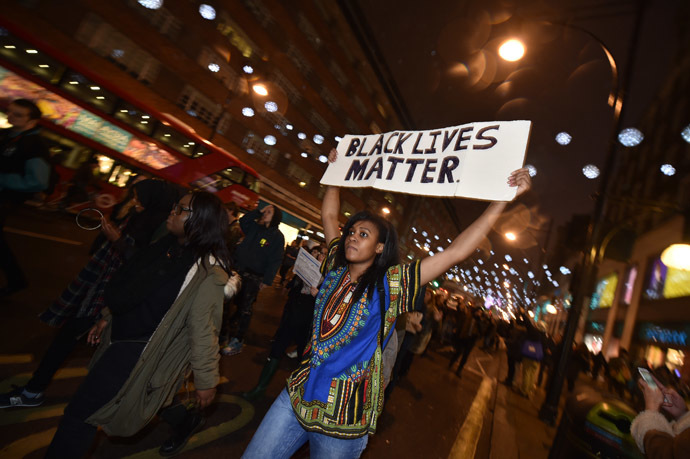
The report suggests that Black Lives Matter protests in the UK in 2020, which is what led to the Commission's establishment, were solely concerned with the horrific murder of George Floyd and racism in the USA. This is not true at all. The protests were calling for justice for George Floyd but also about the racism which exists in the UK including the legacies of enslavement of African people and colonialism which exist today not just in statues and symbols but also policies and practices. 

The report is condescending towards young people and insults their intelligence, gaslighting them also.  In fact, the report seeks to make light of the 'transatlantic slave trade’ or worse still glorifying it as they say:

"There is a new story about the Caribbean experience which speaks to the slave period not only being about profit and suffering but how culturally African people transformed themselves into a re-modelled African/Britain"


They also describe calls to decolonise the curriculum as negative.  They say they want children to 'reclaim their British heritage' but don’t seem to understand the importance of history being taught truthfully and the experiences and achievements of black and brown people in history being included in the curriculum. 

As somebody who has campaigned for black history to be on the curriculum including as part of the Mary Seacole Curriculum Campaign, I do not agree, Black, Asian and minority ethnic children have the right to learn about the histories  and heritage of their parents and ancestors too:

https://www.obv.org.uk/news-blogs/we-ve-won-mary-seacole-olaudah-equiano

Also, in my role as part of the UNESCO Coalition of Artists for the General History of Africa, I promote the 8 volumes of the history of Africa in my work in the arts, the UN recognises the benefits of decolonisation and promoting African history as a way of countering the racism faced by young black people of the African diaspora. 

“The Coalition aims to mobilize and raise awareness of the African youth and diaspora around a number of central themes related to the General History of Africa (valuing African contributions to contemporary societies, promoting a pan-African identity, “decolonizing” minds, celebrating African diasporas.”

https://en.unesco.org/general-history-africa/coalition

  I reject these ideas in the report about history and heritage. It’s crucial for  children to learn about all their roots and heritage , it helps to break down barriers and to instil value and worth.  

The report negatively labels young people, families and negatively targets Caribbean communities specifically. 


Bizarrely the report references the ceremony for the opening of the Olympic games in London as demonstrating progress on race because there were black people featured but fails to  mention that the Olympic games were held in one of the UK's most deprived boroughs and one with the highest ethnic minority population, that many black and minority ethnic communities were displaced because of the Olympics , losing homes and businesses and that the promises of the games benefitting the local community  never materialised. The London borough of Newham is the local authority with   the highest rate of covid deaths which is caused by poverty, overcrowded housing, precarious work and disadvantage.

In fact, as the Olympic games opened in Stratford, BARAC UK was also in Stratford, launching an initiative to address race discrimination at a meeting entitled; Jobs and Justice, Olympics Fair Play for Who?

http://blackactivistsrisingagainstcuts.blogspot.com/2012/07/barac-public-meeting-jobs-justice.html?m=1

In addition, I led a successful campaign against racism by the British Olympics Association, when Britain's biggest black newspaper The Voice was denied 1 single media pass whilst the BBC had over 100. Whilst we won the campaign,  it should not have been necessary. It ought to have been obvious to even the all white BOA committee that black press would have an interest in the Olympic games, I cannot believe they had missed the significant presence of black athletes at the Olympics. 

https://www.campaignlive.co.uk/article/boa-overturns-decision-grant-voice-olympic-stadium-accreditation/1141794?src_site=mediaweek

The report states that instead of focusing on race and ethnicity we need to look at underlying socio-economic issues, but fails to acknowledge that it is due to institutional and structural racism, that those disproportionate impacts linked to socio economic factors, exist. 

The report suggests strangely that if we refer to institutional, structural or systemic racism we are trivialising racism. In the same way we may describe, direct and indirect racism and racist harassment and bullying, it is correct that we refer to the other types of racism which exist. It is wrong to say that we are the ones creating a 'problem' by doing so. 

In addition, the report has misrepresented the meanings of white privilege and white fragility all together. It seems to suggest that success cancels out discrimination and that they are mutually exclusive.

BARAC UK rejects this report, it seeks to divide communities, trivialise and disregard some forms of racism,  gaslights those who experience racism and plays into the hands of those who hold racist views, setting us back not taking us forward.


This statement was published in the Morning Star newspaper on Thursday 8th of April.  Read Here 


Zita Holbourne 

National Chair & Co-Founder BARAC UK

On behalf of BARAC UK 


Monday, 2 May 2016

OPEN LETTER SENT TO DAVID LAMMY ON DISCRIMINATION IN THE CRIMINATION JUSTICE SYSTEM SIGNED BY BARAC UK

Activists send open letter to David Lammy

in 

Press Release: Embargo -Thursday, April 28th 2016 00.01 am
An Open Letter to the Rt. Honourable David Lammy MP concerning the Parliamentary Review of racial bias and BAME representation in Criminal Justice system
On 31st January 2016, The Prime Minister, David Cameron asked David Lammy MP to lead a Review to investigate evidence of possible bias and disproportionate sentencing of African, Caribbean and Asian defendants in the Criminal Justice System. As part of the Equality and Criminal Justice reform. David Lammy MP is to report back in spring of 2017.
The Prime Minister said:
We need to ask the difficult questions about whether the system treats people differently based on race. Charges, courts, prisons and rehabilitation to be scrutinised."
The Rt Hon David Lammy, MP, said:
I've been working in this area for almost 2 decades and am very pleased to accept the Prime Minister's invitation to lead this comprehensive, independent review across our criminal justice system. With over a quarter of the prison population coming from BAME background the urgency is clear. I look forward to leading a team that will evaluate what works in the UK, draw on lessons from abroad and listen to a broad range of voices from the justice system and our BAME communities."
Lord Chancellor and Justice Secretary, the Rt Hon Michael Gove MP, said:
An effective justice system depends on procedural fairness. Equality of treatment at every stage in the criminal justice process is essential. I am very pleased that David, a politician whose intellectual honesty I have long admired, and who is not afraid to confront uncomfortable truths, is pursuing this important work."
There is a need for such a review, as a report entitled Statistics on Race and the Criminal Justice System 2012, produced by the Ministry of Justice found that almost 20% per cent of black and Asian defendants were more likely to be jailed than white defendants for similar offences. The average sentence given to an African Caribbean defendant is seven times longer than that for an average white defendant.
Stop and search figures revealed a similar pattern of over representation, a black person aged ten or older in 2011/ 2012, was 6 times more likely than a white person to be stopped and searched and nearly three times more likely to be arrested.
The same report found that only 26 per cent of white defendants were handed immediate custodial sentences compared to 31 per cent for black defendants and 32 per cent for Asian defendants. Again this differential treatment can be seen in the average custodial sentence for black prisoners was 23.4 months compared to 15.9 months for white prisoners.
Speaking as the Chairman of the Society of Black Lawyers, the former Vice Chair of the Metropolitan Police Authority, and part time Judge, D Peter Herbert OBE said:
the figures showed 'institutional racism' within the system."
We understand that there will be separate but simultaneous meetings of BAME Judges and magistrates to discuss judicial racism and bias.
We as BAME legal groups and the wider BAME organisations and all our various communities would like to collectively express a view and put forward written and oral evidence of anecdotal cases that we know of, and a joint position on solutions, as a way forward. To this end we will be holding a series of meetings to discuss racism and bias in the Criminal Justice System and within our judicial system generally.
We know that there is significant overrepresentation of black, Asian and minority ethnic (BAME) people in the criminal justice system.
Please see the attached letter to David Lammy MP. Please confirm whether you would be willing to attend such meetings by contacting the numbers shown below.

Note to editors and other interested parties:
D Peter Herbert OBE - Society of Black Lawyers: 07973 794 946
Viv Ahmun - Blaksox: 07985 395 166
Ashlee Gomes - NBPA: 07887 635 375
Earl Smith - ABPO: 07810 854 258

Thursday, 4 June 2015

Dear White People - Coming to a cinema near you soon - or perhaps not!


The reluctance of the UK film industry to support black produced and directed films and / or films exploring the issue of race / racism is not a new situation but behind the scenes those involved in trying to get such films screened in cinemas and prevent them going straight to DVD / Blue Ray is a thankless and often unseen task.
This is why Black Activists Rising Against Cuts (BARAC) UK has teamed up with The New Black Film Collective to campaign for Dear White People to be screened in cinemas in July when it goes on general theatrical release in the UK. TNBFC is one of only two black run film distribution companies in the UK and the only black female distribution company. 
Following the withdrawal of lottery funding by the BFI and the withdrawal of Picture House Cinemas in showing the film we have launched a joint petition. SIGN THE PETITION HERE
Dear White People is the creation of black director and writer Justin Simien.  It explores race, racism and identity and is set on a University Campus.  If the film is being rejected because it is perceived to be for black audiences that's bad enough but the clue in the title makes clear that it is not a film aimed only at black audiences.  As a satirical comedy it is a film that can be enjoyed by everyone and the messages in the film are relevant to all. So we are asking you to please sign the petition and share widely but to also contact your local cinemas and ask them to screen it and if they refuse to ask the question why?
Image result for dear white people
Petition Letter 
'Dear White People' is an award winning USA produced satirical comedy-drama film set on a University campus, directed and written by Justin Simien. The film won the U.S. Dramatic Special Jury Award for Breakthrough Talent at the 2014 Sundance Film Festival. Justin Simien has been named in Variety magazine's 2013 "10 Directors to Watch" list.
The film is due for general theatrical release in the UK from July 10thbut so far very few cinemas have agreed to screen the film with no cinemas agreeing to standard full 7 day run. 
The BFI has refused lottery funding to the New Black Film Collective (one of only two black film distribution companies in the UK), which would have supported the distribution of the film with no justifiable reasons given and a major independent arthouse cinema chain has turned it down even though they stated that they like the film.
The suggestion that the film is not mainstream enough and is only suitable for black audiences is not true at all. We believe the film is current and relevant for all audiences in the UK as is evident from the film synopsis below. 
We believe that the response to 'Dear White People' by the UK film industry is part of a wider problem of institutional racism in the industry, whereby films featuring black characters, exploring race and identity and / or made by black producers / directors  are repeatedly rejected for theatrical release, meaning that they go straight to DVD  / Blue Ray release unless they portray black people in negative stereotypical roles or there is a tokenistic response of one-off screenings linked to cultural events such as Black History Month with very limited or no screenings outside of London. 
We believe that 'Dear White People' and other intelligent films exploring the issues of race, racism, identity and intersectionality should be available for mainstream and diverse audiences to view and enjoy and are important in creating dialogue about the issues and in tackling racism.  The issues explored in the film are relevant to UK audiences, tackling racism is a responsibility of all, not just those on the receiving end.  A study carried out by the National Union of Students found that one in six black students in UK universities had experienced racism in their institution, a third felt their educational environment left them unable to bring their minority perspective to lectures and tutorials, and 7% openly labelled their learning environment as "racist".
Many linked their experiences of racism with a drop in their self-esteem, confidence, motivation and desire to continue their education, reporting that they felt marginalised and socially excluded. Worse still, we continue to hear stories of how black students are being pushed down before they've even really had a chance to get their feet off the ground.
Rotten Tomatoes gave the film a rating of 92% saying;
'Dear White People adds a welcome new voice to cinema's oft-neglected discussion of race, tackling its timely themes with intelligence, honesty, and gratifyingly sharp wit.'
The New York Times said of it;
'Everyone should see this movie, and everyone will see it a little differently. Maybe you will think it goes too far, or not far enough. Since I happen to belong to the group to which it is explicitly addressed, a direct response seems warranted. Dear “Dear White People”: Got your message. Keep in touch.'
Variety said:
'“Dear White People” nonetheless provokes admiration for having bothered to ask some of the hard questions without pretending to know any of the answers. It also works as a fine showcase for its actors: Fleshing out characters that could have been little more than one-note mouthpieces, Williams, Thompson, Parris and Bell all make strong, distinctive impressions, with Thompson perhaps the standout as the film’s sharpest and most enigmatic figure.'
We call on cinema chains across the UK to screen 'Dear White People' when it is released in July and to consider screening it for 7 day runs or more and for the BFI to reverse its decision not to provide lottery funding for the distribution of the film. It is important that they are held to account on their commitment and promises around diversity. 
Film Synopsis: 
Sam White is a mixed race film production major at Winchester University, a prestigious and predominantly white school. With her sharp tongued and witty radio show Dear White People and her self-published book, Ebony and Ivy, Sam causes a stir among the administration and student body alike, criticising white people and the racist transgressions at Winchester.
When Sam wins the election for head of house of Armstrong/Parker, the all black house on campus, tensions rise. In winning the election, she beats her ex-boyfriend Troy Fairbanks, the son of the school's dean. Troy harbors dreams of being a comedic writer rather than a lawyer, but his father prefers that he not give white people a chance to profile him, and will accept nothing less than his best. Coco has an issue with Sam because the reality TV producer she is trying to win over would rather do a show on the witty light-skinned black girl than her. Lionel Higgins, a black gay student, gets a chance at finally finding his place at Winchester by being recruited by the school's most prestigious student paper to write a piece on Sam and the black experience at Winchester. When Kurt, a white student and son of the school's president, and his club come up with a blackface theme for their annual party in response to Sam's outspoken show, black students appear at the party, and a confrontation ensues, leading to a brawl.
Black Activists Rising Against Cuts (BARAC) UK & The New Black Film Collective 
Image result for dear white people

One way to support the campaign is to purchase a ticket for the screening of Dear White People at Prince Charles Cinema so that they can release the film during opening weekend. 

http://www.princecharlescinema.com/events/events.php?seasonanchor=dearwhitepeople

You can also get updates about screenings on the Dear White People UK Facebook page via the link below. 

#DearWhitePeopleUk 
www.facebook.com/DearWhitePeopleUK 
There will be a special preview of the film screened in the Houses of Parliament followed by a post film discussion - details to follow in due course. 


Wednesday, 11 March 2015

A WHOLE GENERATION OF YOUNG BLACK PEOPLE REJECTED & FAILED


A WHOLE GENERATION OF YOUNG BLACK PEOPLE REJECTED IN THE LABOUR MARKET  & FAILED BY GOVERNMENT. 


By Zita Holbourne, National Co-Chair BARAC UK 


When Black Activists Rising Against Cuts (BARAC) UK was formed in 2010 a primary focus for our campaign was the expected impact on young black and minority ethnic (BME) workers of austerity and cuts amplifying the discrimination towards them in the labour market that already existed.


Over the past five years the disproportionate impact of cuts on this group has been largely ignored or disregarded by government, politicians and media alongside the double impact on black and minority ethnic women and black workers generally.


When young black people are featured it is to demonise them and blame them rather than to look seriously at the crisis they face, which has included the scrapping of EMA, tripling of university fees, lack of work opportunities,  discrimination in the labour market and the increase in zero hour contracts and casual work as the only option when they do get a foot in the door, as well as the knock on impact of their families being  hit by poverty because of job cuts, increased pension contributions for public sector workers, pay freezes, low pay and discrimination at work.  There are over a million young people unemployed but one in two young BME people are without work.  But in addition to this, the failure to adhere to the McPherson recommendations arising out of the Stephen Lawrence Inquiry, means that institutional racism in the police forces still impacts on young black people.  They are racially profiled and targeted disproportionately in stop and searches, up to 33 times more likely to be stopped than their white counterparts.  They face racial and religious stereotyping and harassment in education, the workplace and wider society. 


Today the Labour Party has released a report based on official figures from the House of Commons, revealing that there are now 41000 16 to 24 year olds from black and minority ethnic communities long term unemployed – a 49% rise since 2010, with the number unemployed for more than a year having risen by 50% since the con-dem coalition.  A Labour Party spokesperson has declared his astonishment at the figures but the question is what is Labour doing and what commitment are they giving to address this horrendous situation? 


Equality Impact Assessments are treated largely as a tick box exercise.  When a  Judicial Review was taken by a union because redundancies impacted disproportionately on black (and disabled) staff a  judge ruled that a made up retrospective diversity impact assessment was suffice to demonstrate due  regard indicating that the courts have no real understanding or training on EIAs and the equality duties. When black workers or applicants do wish to pursue legal action the fees for Employment Tribunal prohibit austerity stricken would be claimants from lodging cases.


In 2010 BARAC served a Freedom of Information request on the Treasury asking them for an Equality Impact Assessment to demonstrate what consideration they had given to the impact on race of their proposed cuts.  Their response was to cite public interest immunity as a reason for not making the EIA public.


The cuts to the EHRC have meant that work on enforcement has reduced despite a damning report produced by the CRE just before they ceased to exist which demonstrated that the majority of public sector organisations were failing to comply with the equality duty.


In a speech to the CBI in November 2012 David Cameron said he was ‘calling time’ on equality impact assessments describing them as ‘bureaucratic nonsense’ and ‘tick box stuff’. He said they were unnecessary because there were enough ‘smart people in Whitehall’ who would think about equality when developing policy.


As a mother of a young black man I have witnessed first-hand the soul destroying attitude of employers towards young black people in the labour market and had to advise, campaign and represent some of those young black people in cases against educational institutions and workplaces / industries.


My son is in his final year of university but when he approaches employers in the industry he wants a career in and has studied for the past three years to work in he is largely ignored. Letters seeking not just paid work but internships, work experience, shadowing etc. are ignored and he does not even receive a response the vast majority of the time.  When he does it is to inform him that he must have experience in order to be successful in securing opportunities to gain experience. The whole point is that he needs the opportunities to gain experience to apply for jobs. One employer for a part time job he applied for working in a coffee shop told him that he wasn’t suitable even though he had recent experience in the catering industry, because he wasn’t experienced in making coffee. What happened to training people to do a job? How long would it take to train someone to make coffee?  The truth is that it has nothing to do with experience but an excuse to reject young black people by employers, many of whom have no regard for equality legislation or policies. 


 The experience of many young BME people trying to enter the labour market is that employers are not interested in giving them opportunities or investing in them for the future. Many public and voluntary sector employers are still cutting jobs as part of the con-dem coalition’s austerity measures and when young black people do get jobs they often experience a climate where institutional racism and harassment and bullying are allowed to thrive. Every day is a battle for survival; job satisfaction and security are alien concepts.  The jobs available are minimum wage, casual and temporary posts and mostly zero hour contracts.  This means that they can’t plan for the future, save, rent a home – let along think about buying one - and they don’t know if they will earn enough to survive from one week to the next. 


Cuts to the public and voluntary sector mean that the opportunities are no longer there for a new generation of black workers. There were over 37,000 less BME public sector workers in 2012 than 2010 with the biggest losses in the South East with 12,702 less BME workers. Of the 17,000 voluntary and community organizations working with minority ethnic communities in the UK, 53% had received funding from statutory sources and many of these organisations have been forced to close their doors because of funding cuts.  Forcing public sector workers to work longer in order to receive their pensions mean that young people will be practically middle aged before they event get a foot on the career ladder in the public sector.


Instead of blaming each other for this crisis political parties ought to be seriously looking at an urgent and robust action plan to address this horrendous discrimination and not just talking about it but putting their words into action.  Young black people don’t have a whole lifetime to waste in poverty and misery waiting for government to address this and should not have to live like third class citizens in the meantime – a whole generation being failed and rejected.


In the wake of a general election, black communities don’t need to hear from political candidates how terrible it all is – we know this – we are living and breathing it and as a parent it fills you with anger, dread and pain in equal measures to know that a worse future is being passed to your children than was passed to you by your parents who faced horrific racism.  What we need to hear and see is real and urgent commitment, effort and action to address this gross discrimination.  In the meantime we should consider boycotting those employers who discriminate against young BME people. 


Wednesday, 3 December 2014

SEPARATED BY BRICKS, MORTAR & WHITE PRIVILEGE: REPORT ON THE CAMPAIGN AGAINST EXHIBIT B IN FRANCE


SEPARATED BY BRICKS, MORTAR & WHITE PRIVILEGE: REPORT ON THE CAMPAIGN AGAINST EXHIBIT B IN FRANCE:

By; Zita Holbourne, National Co-Chair BARAC UK & Boycott the Human Zoo Campaign UK 


From August to September 2014, black community organisations,  anti-racist organisations, trade unions,  artists and individuals came together to form the Boycott the Human Zoo campaign against the hosting of Exhibit B in London by The Barbican.  The campaign petition, started by activist, Sara Myers, gained over 20,000 signatures but the organisations that formed the campaign represented over a million members.

Exhibit B is an art exhibition by white South African, Brett Bailey. Thirteen installations feature black actors, who are not allowed to speak or move in a re-enactment of human zoos and ethnographics popular during the late 19th and early 20th centuries. There is no narrative on the resistance to colonial rule by black people, no celebration of our achievements or acknowledgment of any other aspect of our histories . The exhibition is insulting, offensive and racist. 


The Barbican was reluctant to engage with us and on the opening night of the exhibition we protested outside the venue. The Barbican cancelled the London showing of Exhibit B that evening.  They then issued a statement which sought to demonise protestors describing us as threatening and extreme. http://www.morningstaronline.co.uk/a-2721-When-prejudice,-power-and-privilege-join-forces,-resistance-is-necessary#.VH5PUmeS5EM

At the end of November Exhibit B was hosted by the Theatre Gerard Philip in Saint Denis, a suburb of Paris with a high black population.  As with The Barbican the theatre is a cultural centre where the works of local black artists are seldom seen. In France a petition initiated by historian and lecturer John Mullen has gained over 20,000 signatures and black community groups together with artists and anti-racists have organised a campaign against Exhibit B being hosted in St Denis and in Paris, opening on 7th December.  

artwork by Zita Holbourne

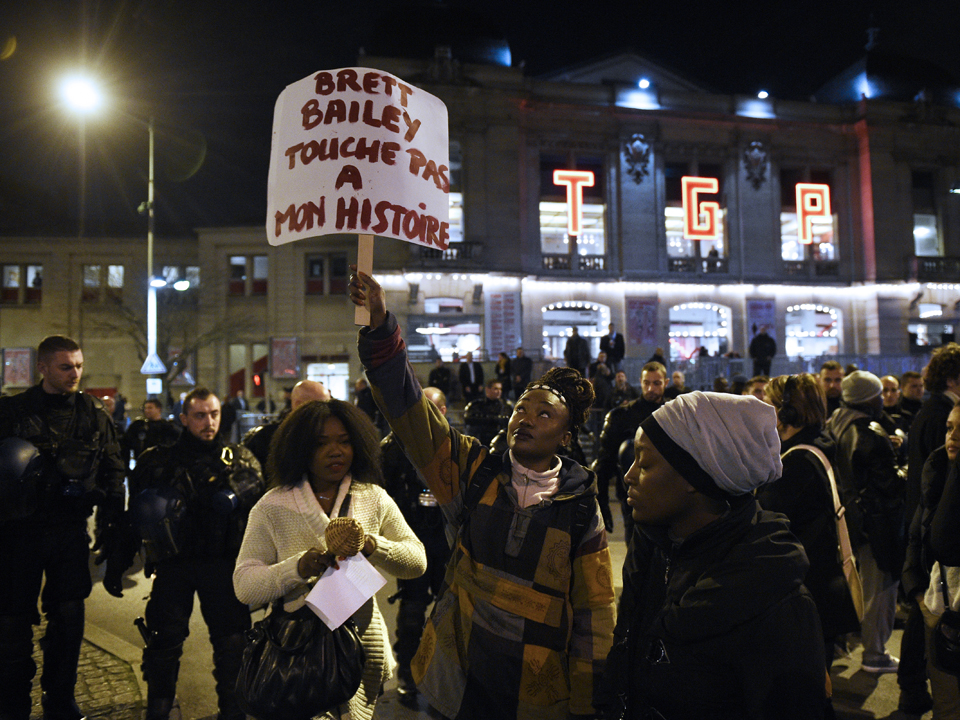
On the opening night of Exhibit B in Saint Denis hundreds of campaigners protested. They removed the sets of metal barriers in front of the theatre and a window was broken. Protestors spoke with those coming to see Exhibit B and some turned away as a result of the protest and the rest of the evening’s showings were cancelled.

The press demonised the protestors, resorting to personal insults directed at the organisers and the same kind of negative, offensive and nasty comments directed at campaigners in the UK against Exhibit B, branding them as extremists.  One of the campaigners, musician Bams, appeared on a major chat show alongside white sociologists, supporting Exhibit B, who had the audacity to try to tell her, a black woman that she did not understand racism or anti-racism!    


A public debate that was supposed to take in a spectrum of views, including representation from the campaign against Exhibit B, was cancelled, according to the organisers ‘because of the extremist nature of the protestors’.

On the following night two hundred or so protestors were greeted by hundreds of riot police and French armed forces, National Gendarmerie sent to intimidate them. Despite this, protestors stood firm and chanted demanding ‘Respect!’ and ‘Dignity’.  Some went to speak to spectators and engaged in discussions about why they were there. 


Brett Bailey claims that he and his art are anti-racist yet his response to the abuse and intimidation of protestors in defence of his art was; "My performers are full of fire. My team is full of fire... Rage, rage against the dying of the light. The show will go on,"  It is quite incredible that he can claim to be against racism and to be creating his art to challenge racism but have no concern about the police violence black people are facing as a result of it. 
On the third night, the police and armed forces became even more violent using tear gas and clubbing protestors.

It is horrific that black people in France are being brutalised and demonised for standing up against Exhibit B. It is astonishing that any artist would find it acceptable to put on an art exhibition surrounded by armed police in riot gear, barricading the entrance to it,  whilst attempting to terrorise and intimidate black people. 

Sketches by Zita Holbourne


Writing for a South African newspaper, Bailey entitles his piece ‘Blood on the Tarmac’ referring to a protestor he witnessed being brutalised by French police.  He describes watching from the safety of a window inside the Theatre, the security arrangements put in place to try and frighten protestors off. 

He says ‘But out there on the floodlit street, beyond the barricades, this is not understood. Those people have not attended the performance. None of this is really about Brett Bailey or EXHIBIT B’.  He claims that protestors have not understood his art because they have not seen it in the same way that board members at The Barbican said that we could not say that Exhibit B was racist because we had not seen it. This is a ridiculous argument, I don’t need to see the BNP attack a black person to know that they are racist and in any case  the Barbican, bar one board member,  had not seen it before deciding to book it.  He then has the arrogance to suggest that the protests are nothing to do with his exhibition but to do with the racism that black people face in society, the same racism they are facing now, demonised, labelled and threatened by police, politicians and the media.  But Bailey does not engage with the black people he purports to care so much about, he does not even appear to recognise the irony of his claiming to produce anti-racist art which is protected by racist police, who attack black people.  Bailey goes on to blame not his art but activists in London for what is happening now.


Brett Bailey looks on protected and separated by bricks, mortar and white privilege, from the living reality of black communities facing deepening racism globally. When asked if he is ‘following’ what is happening in Ferguson, he replies ‘from afar’. It is not possible to distance yourself from racism but at the same time claim to produce anti-racist art.

Protestors here and in France have been accused of censorship of  art, but  we have never called for the work to be censored but for arts institutions to withdraw from hosting it, acknowledging the negative impact on black communities and taking action to address institutional racism in the arts and culture sectors.  Both in the UK and in France campaigners against Exhibit B have included a range of artists.  We are not anti-art but anti –racist.  Rather than being for censorship, we are for equality, humanity, dignity and respect.

Solidarity with sisters and brothers in France standing up to the voyeuristic, racist, demeaning and insulting human zoo. 


The exhibition reopens in Paris at the Cent Quatre (104) and runs from 7th to15th December and there will be more protests taking place - please give your support to them.