Blog Archive

Showing posts with label Exhibit B. Show all posts

Tuesday, 14 July 2015

Open letter to the Galway International Arts Festival from Boycott the Human Zoo Campaign

supporters


Open Letter to the Galway International Arts Festival from Boycott the Human Zoo Campaign 


14th July 2015


John Crumlish, CEO, Paul Fahy, Artistic Director
Galway International Arts Festival
Administration Office
Black Box Theatre
1 Courthouse Square
Duke Road
Galway
Republic of Ireland


Dear Mr Crumlish and Mr Fahy

We the undersigned are writing to you regarding your inclusion of the racist installation 'Exhibit B'in the 2015 Galway International Arts Festival.

As the Boycott Human Zoo Campaign; a coalition of anti -racist, Black community organisations, arts organisations and trade unions, we want to be clear that Exhibit B is not simply a ‘controversial’ art installation; it is an installation which features racism both in its content and in the process by which it has come to be put into the public domain.

As the UK campaign group Boycott the Human Zoo and associated organisations, we engaged in extensive public consultation and dialogue with people across communities in the UK and internationally. The overriding opinion was that the performance installation ‘Exhibit B’ is racist and immensely offensive and the curator Brett Bailey's alleged ‘educational’ message is lost to the point where it is a parody of itself and manifests the racism it claims to challenge. In addition, Mr Bailey's evident lack of understanding of the subject matter, and his disconnect from the social and political climate, results in distress, anxiety, tensions and public protest as seen in the increasing global voice - which continues to increase exponentially - requesting that the work be decommissioned and removed from programming in their towns and cities globally.

The recent protest events seen in the UK, Paris, Amsterdam and Brazil are part of a global response to the constant and continued de-humanisation of Black and migrant communities across the world.  After consideration, the city of Toronto refused to allow the exhibition to take place there due to the negative impact and offence it would cause for Black communities.  It is simply not enough for the artist, commissioners and venues - all of whom are speaking from a position of white privilege and none who are qualified in determining what is and is not racist - to state ‘it is not racist’; and that their word is the final word. A consortium of experts in racism, prejudice, discrimination and inequality from across the world have on multiple occasions unpacked and explained the ideology and methodology of racism that is prevalent in the process and accompanying actions of both the artist and the commissioners and hosting venues, and why the piece and the commissioning process are both examples of how racism manifests in the 21st Century under the framework of inherited draconian and archaic decision making that replicates and reinforces its colonial origin.

Hosting this installation and ignoring the vast surge of public opposition suggests that whereby politicians, organisations, institutions and select individuals can set the parameters of what is acceptable and accessible or not, we – the voice of the people, and particularly the voice of Black  people and communities– have no say. Our voice is being censored whilst at the same time we are being accused of censoring art for standing up to racism. Our profound understanding of racism in both ideology and methodology is dismissed. That in and of itself  is a clear example of the systemic and institutional racism that continues to manifest in current times.

Our collective voices include those that have seen the exhibition and actors who auditioned and declined involvement as well as those that have participated. The collective voice resulted in petitions in several countries including 23,000 signatures in the UK and of 20,000 in France. in the UK the organisations that make up the Boycott Human Zoo Coalition total over a million people in membership.

Over one million people around the world are saying ‘No’ to ‘Exhibit B’ including politicians, academics, activists, community leaders, artists (writer, poets, rappers, visual artists and musicians) plus ordinary people, black and white.  Each one of us see it for what it is, highly offensive, deeply insensitive and a tool to uphold the system of white supremacy and privilege that allows this work to be projected on society, while reaffirming that the attitude of white superiority and automatic entitlement is somehow acceptable and unchallengeable and takes priority over all else.

The protests against ‘Exhibit B’ in the UK successfully related the message that this piece should not have been shown in the UK and its intended run at a London venue was cancelled. Our ongoing work clarifies why this is not about ‘censorship’ - the predictable and lazy response for supporters of ‘Exhibit B’ - it is about the disconnected and uninformed process by which this piece came to be commissioned. It is not anti-art but anti-racism.

The artists and commissioners of these kinds of offensive propaganda manifestations veiled as art are stating they wish to have equality of access to appropriate or misappropriate diversity of culture and life experience, while at the same time being completely devoid of that same said culture or life experience being any part of the initiation or fundamental decision making process. The result is a juxtaposition notion that it is somehow acceptable to have discrimination and under representation in the decision making process of the very meaning of what equality is. 

To suggest, as the artist does, that the mere existence of his piece is a form of anti-racism and initiates dialogue is an arrogant and subversive appropriation of the real work that goes on to challenge racism through honest and legitimate artistic, academic and political means and methods. ‘Exhibit B’ is not part of the solution, it is part of the problem – as can be seen through the vast protests and the subsequent treatment and depiction of the protestors.  The resulting irony of the modern-day dehumanisation, demonstration and harassment directed at those speaking out cannot be ignored.

It is incredibly naive and condescending of the artist and the supporters and funders of ‘Exhibit B’ to suggest that we somehow ‘don’t get it’. Not only do we understand on a profound level which the artist would never begin to understand; we do not know the issues by association, we do not understand the topic vicariously, we do not dip in and out at times of our own choosing and we do not engage by selective appropriation. We live with covert and overt - and all the subtle nuances of racism - and live with the consequences and legacy of historical racism daily.

This piece is a propaganda vehicle for the artist as we have observed though our close inspection and observation over the past year. The inconsistencies and contradictions in the artist’s explanation, justification and narrative of his work are evident to anyone who took the time to read the articles and social media posts by Brett Bailey. The artist revealed he neither understands the subject matter with which he is using as his artistic playground, nor the results of his folly.

The extremely misleading literature contained on the artist’s website provides statistics relating to where the installation has been shown and favourable reports, it does not however refer to the overwhelmingly larger number of people that have opposed its residency in their towns, cities and countries.

It is profoundly disturbing to see the sheer level of physical force used against Black people who speak out against ‘Exhibit B’. That the army was brought in and the protesters were tear gassed and pepper sprayed for standing up and exercising their right to protest in Paris, is directly connected to a resurgence of the civil rights movement reminiscent of the 1950’s that we see across America and around the globe.

Are the civil rights activism of the past decades and centuries to be forgotten so readily? Does the Galway International Arts Festival think this crude regression is the image the Republic of Ireland and the people of Galway want to send as a message as to how it views Black and migrant people?

Is one man’s quest to insult and offend, whether inadvertently or unintentionally or otherwise, of more importance than those who live in a country, where they are now revisiting the oppression and subjugation of the past that manifests in nuanced neo-colonialism and neo-liberalism, which condescends us with; “this is good for you”, “you misunderstand”, “you are uneducated” and “we know best”? An artist who reinforces racial stereotypes and actively practises racial profiling calling the intelligent campaign of opposition to his work an “angry violent mob” and dehumanising the protesters and feeding the stereotype of Black people in mainstream media. All this despite there being peaceful protest with no record of violent incidents.

It is essential to understand that the finance and resources available to the artist, producers and commissioners of ‘Exhibit B’ create a luxury of time and opportunity by which to voice their views. This luxury of time, finance and opportunity are not afforded to those who call for its decommission. That in itself reveals the inequality at play here and the systemic construct of white privilege that frames this matter. It is by no coincidence that there was an extraordinary imbalance of available resource between the campaign initiated by an African-Caribbean-British mother from Birmingham who was incensed enough by the racism of ‘Exhibit B’ to start an online petition and The Barbican and it’s all white senior management and board of governors who nonchalantly signed-off the commission without any consultation with, or understanding of, the communities who feature within this installation, a community who would ultimately pay the price of the racist installation.

The road to equality is not through the production of ‘Exhibit B’ and art that reinforces racist stereotypes, it is in the ceasing of commissioning of such works and a change in the procedures and processes by which they come to be commissioned and access to opportunities for black artists.

It is one thing to support art and freedom of expression, but it is something entirely different to support racism and propaganda guised as ‘art’- the publicity of which only serves to benefit one individual; the artist - who will ultimately be reaping the promotional and economic benefits long after the alleged installation ‘message’ is forgotten.


It is for all these reasons that we call on Galway International Arts Festival to decommission 'Exhibit B' from its program. 

As you have programmed 'Exhibit B' as part of your Galway International Arts Festival, we kindly request that you furnish us with all the details of your consultation process and those you engaged with - particularly from Black communities - in order to obtain your decision to proceed with this commission. It is of significance  that Galway International Arts Festival receives 28% of finances from public sector grants - which brings with it further requirement for transparency and responsibility.

There is a real opportunity for art institutions and politicians, who themselves are significantly lacking in diversity, to understand how we stop the cycle of inequality, division and discrimination and work together on the solution. The decommissioning of ‘Exhibit B’ is a start.


Yours Sincerely,

Sara Myers, Founder of Boycott the Human Zoo
Zita Holbourne, National Co-Chair Black Activists Rising Against Cuts (BARAC) UK & PCS Union NEC, Poet, Visual Artist & Curator
Lee Jasper, National Co-Chair BARAC UK  & Movement Against Xenophobia Steering Group
John Mullen, Collectif contre Exhibit B, France
Marcos Ferreira, Contra Exhibit B, Brasil
Donna Guthrie, BARAC Women's Officer & UCU staff Unite Branch Executive Committee
Paul Richards, Creative and Educational Director of BrazenBunch & UpRise
Rosemary C Adaser, Founder Member, Mixed Race Irish
Sharon Murphy, Black Irish & Singer, Songwriter 
Ngoma Bishop, Author, Arts Campaigner, & Chief Officer of BEMA
Austin Harney, Chair Campaign for the Rights for the Irish Communities (CRAIC) & SERTUC Race Relations Committee Secretary
Zena Edwards, Spoken Word Artist & Creative and Educational Director
Adrienne Frye, British Black List 


supporters


Tuesday, 17 March 2015

A FUTURE WHERE ART AND CULTURE IS FOR EVERYONE; WRITTEN BY ZITA HOLBOURNE


Artwork by Zita Holbourne


Last year my organisation BARAC UK, was part of a campaign to Boycott the Human Zoo.  The Barbican, an internationally acclaimed arts institution in London were hosting an art exhibition  by Brett Bailey which re-enacted the human zoos of the Victorian age, where black people were placed in cages on display for visitors like animals in a zoo.  Brett Bailey’s exhibits used real black people in different states of undress, chained and caged.   The campaign to boycott the human zoo was joined by hundreds of thousands; we were anti-racist organisations, black arts organisations, community organisations, trade unions and a broad range of creatives including artists, writers, musicians, rappers, poets, graphic designers. 


The Barbican refused to engage with us, we had to lobby and send an open letter to the City of London Corporation who own the Barbican before they would meet with us.  They told us that Exhibit B was important work but could not or would not answer who it was important for; they arrogantly told us it was not racist, but completely rejected our view that it was, disregarding our lived experience of racism and of the legacy of historic racism.

The aim of the exhibition we were told was to confront white people and make them feel guilty about racism, but there was nothing about the resistance historic or current to racist atrocities by black people, nothing about our achievements and the black actors in the exhibits were not allowed to speak.

March to the Barbican; Boycott the Human Zoo

The Barbican confirmed that they had not carried out an equality impact assessment of the exhibition or considered the impact on black communities – let alone consulted them, that they had only one single black member of their Board and senior management team and that none of them had any equality expertise.  They told us that they did not know who the black community was and when they took the decision to close Exhibit B on the opening night after we protested outside they branded us extremist and threatening.   News reports described  us as ‘dreadlocked, placard and drum brandishing ‘ who were ‘censoring’ art.  Our protest was loud but peaceful, there were no arrests, no injuries and no damage and suddenly the very arts that the Barbican as a major arts organisation should be promoting – musical instruments, songs, home-made placards and art work were deemed threatening by them.


Our campaign was anti-racist, not anti-art.  Many of those involved in the campaign were involved in the arts and culture sector.  We found the human zoo to be racist, a horrific insult, offensive and shocking. However we never called on the artist to stop producing his art, but on the Barbican to not host it, to take into consideration those who were negatively impacted by the exhibition.  


 They kept telling us we should go and see it but we had already watched still images and a video walk through of all the exhibits and that was horrific enough for us. The £20 entry fee would prohibit the majority of poor black (and working class white) families from visiting the exhibition even if they wanted to.  There was no education programme and no voice for black people in the exhibition.


The Barbican is situated in the city of London surrounded by a multi-cultural social housing estate including black and minority ethnic communities yet they claimed to not know who the black communities were.  There lies the problem.  Many of the productions involving black artists put on by The Barbican are featuring International artists.


Young black artists trying to build a career are barred from such arts institutions because of the institutional racism that exists which is now amplified by austerity measures.   If their art is focused on race, culture and identity they are told to go away and do something more mainstream on one hand but then are expected to fulfil narrow, stereotypical roles on the other hand.  Black actors for example are cast either as unsavoury characters, criminals, drug dealers etc. or all singing and dancing, not as doctors or lawyers or other professionals.  It’s because of this that many British based actors and musicians have been forced to pursue their careers in the USA. 

Image result for idris elba
Idris Elba, Actor


As austerity bites deeper, black people are amongst the hardest hit, when you are struggling to make ends meet - as poverty deepens even working families are forced to go to food banks - there is no money left over to spend on tickets to go to the theatre, music concerts or exhibitions.


Funding cuts for the arts mean that free or subsidised events that may have been available before have drastically reduced. A government commissioned report last year suggested that by 2015 local authorities would have zero budgets for arts and culture.  This means that opportunities to hone talents for young creatives as well as opportunities to attend art events are not there for the poorest.  It also means that work through the arts to promote equality and diversity, celebrate multiculturalism and mark religious and cultural events has been cut. London mayor Boris Johnson cut funding for Black History Month from £132,000 to £10,000 in 2010, funding for Jewish events were halved and funding for St Patrick’s Day was also cut. There has also been a cut in central government funding of £80 million resulting in 58 arts organisations losing their funding.  Black history month has been reduced in many boroughs to a tokenistic acknowledgment and in one of London’s most multi-cultural boroughs it has been reduced to one week and been renamed as Newham Heritage Week – completing disregarding the aim and purpose of Black History Month when it was first established.  In 2012 a concerned citizen served a freedom of information request on Newham Council to ask them what events they had held to mark black history month.  Their response was that for the week allocated for their ‘Heritage Week’ they had a one page article in their journal and that libraries had posters and displays of books about black history.   No public events, no storytelling, performances, speakers, exhibitions.  You would be forgiven for missing black history month all together if you were a Newham resident. Unfortunately this is not an isolated example.


Black Women in Focus art exhibition


Workers at London’s iconic museums and galleries are so poorly paid that they cannot even afford to purchase lunch in the prestigious areas they work and struggle to meet transport costs to and from work. Members of the PCS union at the National Gallery have taken three sets of strike action with more planned this month to oppose planned privatisation.

Image result for pcs national gallery strikers
Rally and Strike by PCS at the National Gallery


Last weekend I spoke at a conference on the future of arts and culture organised by trade unions and arts organisations and two young black artists Antonietta Torsiello and Samia Malik spoke in workshops about their experiences challenging racism in the arts industry. The conference was aimed at exploring the impact of budget cuts on and calling for public investment in art and culture. For every £1 invested in arts and culture up to £6 is generated for the economy.  2.5 people are employed in the creative industries. So it’s good for the economy but it’s also good for the soul.  Art promotes well-being and builds links and understanding. It is a powerful tool in education and therapies for development and healing.  Yet it is vulnerable and marginalised communities that have the least access. 

Speakers at the Future of Arts and Culture Conference


We should be celebrating the multi talents we have across all communities, faiths, ages, races and classes. Art should not be a privilege for the wealthy.  The UK has benefitted socially and economically from the arts brought to the UK by migrants over many decades and the sons, daughters and grandchildren of those migrants should not now be prohibited from participating in and enjoying the arts because of institutional racism in the sector or cuts and austerity.  Economic recovery needs growth but the government have disregarded the economic benefit of the sector.

Front left: Samia Malik, Speaker, Front Right, Antonietta Torsiello, Speaker


There’s an urgent need for an alternative vision for arts and culture which is inclusive not exclusive, that is publicly funded and accessible for all. Art and culture is for everyone.  #showculturesomelove.

Video of artist, designer & activist Samia Malik speaking in a workshop at the Future of Arts and Culture conference.


Wednesday, 3 December 2014

SEPARATED BY BRICKS, MORTAR & WHITE PRIVILEGE: REPORT ON THE CAMPAIGN AGAINST EXHIBIT B IN FRANCE


SEPARATED BY BRICKS, MORTAR & WHITE PRIVILEGE: REPORT ON THE CAMPAIGN AGAINST EXHIBIT B IN FRANCE:

By; Zita Holbourne, National Co-Chair BARAC UK & Boycott the Human Zoo Campaign UK 


From August to September 2014, black community organisations,  anti-racist organisations, trade unions,  artists and individuals came together to form the Boycott the Human Zoo campaign against the hosting of Exhibit B in London by The Barbican.  The campaign petition, started by activist, Sara Myers, gained over 20,000 signatures but the organisations that formed the campaign represented over a million members.

Exhibit B is an art exhibition by white South African, Brett Bailey. Thirteen installations feature black actors, who are not allowed to speak or move in a re-enactment of human zoos and ethnographics popular during the late 19th and early 20th centuries. There is no narrative on the resistance to colonial rule by black people, no celebration of our achievements or acknowledgment of any other aspect of our histories . The exhibition is insulting, offensive and racist. 


The Barbican was reluctant to engage with us and on the opening night of the exhibition we protested outside the venue. The Barbican cancelled the London showing of Exhibit B that evening.  They then issued a statement which sought to demonise protestors describing us as threatening and extreme. http://www.morningstaronline.co.uk/a-2721-When-prejudice,-power-and-privilege-join-forces,-resistance-is-necessary#.VH5PUmeS5EM

At the end of November Exhibit B was hosted by the Theatre Gerard Philip in Saint Denis, a suburb of Paris with a high black population.  As with The Barbican the theatre is a cultural centre where the works of local black artists are seldom seen. In France a petition initiated by historian and lecturer John Mullen has gained over 20,000 signatures and black community groups together with artists and anti-racists have organised a campaign against Exhibit B being hosted in St Denis and in Paris, opening on 7th December.  

artwork by Zita Holbourne

On the opening night of Exhibit B in Saint Denis hundreds of campaigners protested. They removed the sets of metal barriers in front of the theatre and a window was broken. Protestors spoke with those coming to see Exhibit B and some turned away as a result of the protest and the rest of the evening’s showings were cancelled.

The press demonised the protestors, resorting to personal insults directed at the organisers and the same kind of negative, offensive and nasty comments directed at campaigners in the UK against Exhibit B, branding them as extremists.  One of the campaigners, musician Bams, appeared on a major chat show alongside white sociologists, supporting Exhibit B, who had the audacity to try to tell her, a black woman that she did not understand racism or anti-racism!    


A public debate that was supposed to take in a spectrum of views, including representation from the campaign against Exhibit B, was cancelled, according to the organisers ‘because of the extremist nature of the protestors’.

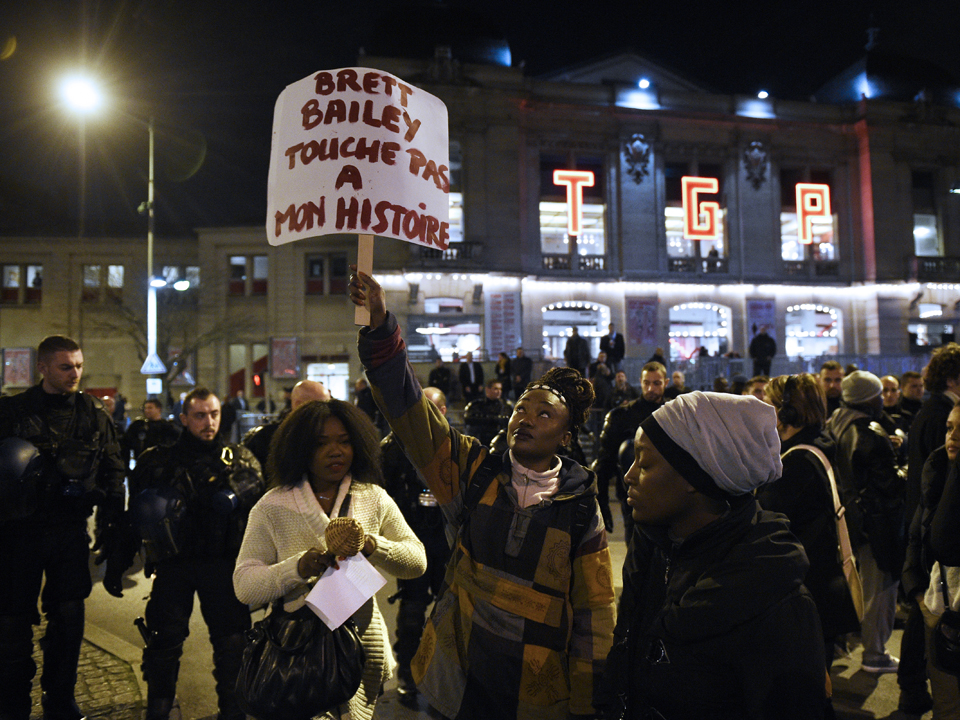
On the following night two hundred or so protestors were greeted by hundreds of riot police and French armed forces, National Gendarmerie sent to intimidate them. Despite this, protestors stood firm and chanted demanding ‘Respect!’ and ‘Dignity’.  Some went to speak to spectators and engaged in discussions about why they were there. 


Brett Bailey claims that he and his art are anti-racist yet his response to the abuse and intimidation of protestors in defence of his art was; "My performers are full of fire. My team is full of fire... Rage, rage against the dying of the light. The show will go on,"  It is quite incredible that he can claim to be against racism and to be creating his art to challenge racism but have no concern about the police violence black people are facing as a result of it. 
On the third night, the police and armed forces became even more violent using tear gas and clubbing protestors.

It is horrific that black people in France are being brutalised and demonised for standing up against Exhibit B. It is astonishing that any artist would find it acceptable to put on an art exhibition surrounded by armed police in riot gear, barricading the entrance to it,  whilst attempting to terrorise and intimidate black people. 

Sketches by Zita Holbourne


Writing for a South African newspaper, Bailey entitles his piece ‘Blood on the Tarmac’ referring to a protestor he witnessed being brutalised by French police.  He describes watching from the safety of a window inside the Theatre, the security arrangements put in place to try and frighten protestors off. 

He says ‘But out there on the floodlit street, beyond the barricades, this is not understood. Those people have not attended the performance. None of this is really about Brett Bailey or EXHIBIT B’.  He claims that protestors have not understood his art because they have not seen it in the same way that board members at The Barbican said that we could not say that Exhibit B was racist because we had not seen it. This is a ridiculous argument, I don’t need to see the BNP attack a black person to know that they are racist and in any case  the Barbican, bar one board member,  had not seen it before deciding to book it.  He then has the arrogance to suggest that the protests are nothing to do with his exhibition but to do with the racism that black people face in society, the same racism they are facing now, demonised, labelled and threatened by police, politicians and the media.  But Bailey does not engage with the black people he purports to care so much about, he does not even appear to recognise the irony of his claiming to produce anti-racist art which is protected by racist police, who attack black people.  Bailey goes on to blame not his art but activists in London for what is happening now.


Brett Bailey looks on protected and separated by bricks, mortar and white privilege, from the living reality of black communities facing deepening racism globally. When asked if he is ‘following’ what is happening in Ferguson, he replies ‘from afar’. It is not possible to distance yourself from racism but at the same time claim to produce anti-racist art.

Protestors here and in France have been accused of censorship of  art, but  we have never called for the work to be censored but for arts institutions to withdraw from hosting it, acknowledging the negative impact on black communities and taking action to address institutional racism in the arts and culture sectors.  Both in the UK and in France campaigners against Exhibit B have included a range of artists.  We are not anti-art but anti –racist.  Rather than being for censorship, we are for equality, humanity, dignity and respect.

Solidarity with sisters and brothers in France standing up to the voyeuristic, racist, demeaning and insulting human zoo. 


The exhibition reopens in Paris at the Cent Quatre (104) and runs from 7th to15th December and there will be more protests taking place - please give your support to them.


Wednesday, 24 September 2014

VICTORY FOR BOYCOTT THE HUMAN ZOO CAMPAIGN - AS PROTESTORS CLOSE DOWN THE ENTIRE LONDON SHOW

ARTWORK BY JON DANIEL


After a month of campaigning against the degrading offensive racist human zoo  exhibition - known as Exhibit B, hosted by the Barbican, the 'boycott the human zoo' campaign has succeeded in closing it down on the opening night of the exhibition.  

This is a victory not just for the team of campaigners  which BARAC UK was proud to be a part of and who worked tirelessly, several behind the scenes, but the 22,500 people who signed Sara Myers' (who led the campaign) petition calling on the Barbican to withdraw the exhibition. Plus all the organisations that formed the campaign, representing over 1 million members as well as every individual who took part in the campaign.

We sent a clear message to The Barbican and to all institutions that are racist that black communities in the UK will not stand back and be disrespected. 

We have succeeded in stopping the human zoo in London but it is due to go to other countries, so a global response is needed.  Here in the UK a public inquiry and serious measures to address the deep rooted institutional racism that exists in the arts and culture industry  which is amplified by austerity and cuts to arts funding is needed. 

Drummers line the entrance to The Vaults


A fuller update will follow including details of a victory party. Please note and pass on that, as a result of the the entire London show being cancelled the planned protests outside the vaults for the rest of the week are also cancelled.
                                                                                      
Celebrating our Victory with some of the organisers of the campaign
Zita Holbourne, co-chair of BARAC UK with letter from the Vaults confirming the cancellation of the entire show


Protestors outside The Vaults Entrance (boycott the human zoo art)


Sara Myers who started the campaign and petition with Co-Chair of BARAC UK, Lee Jasper & letter confirming cancellation of the show


Protestors block the entrance


Donna Guthrie, BARAC Women's Officer who handled the campaigns social networking


Thank you for your participation in this campaign. People Power! Collective Action! Unity!