Open letter regarding the Race Report from those directly impacted by the Windrush Scandal and individuals and organisations who have campaigned for justice with them.
Co-signed by BARAC UK and BAME Lawyers for Justice representatives including National Chair of BARAC UK Zita Holbourne and National Women's Officer of BARAC UK Donna Guthrie
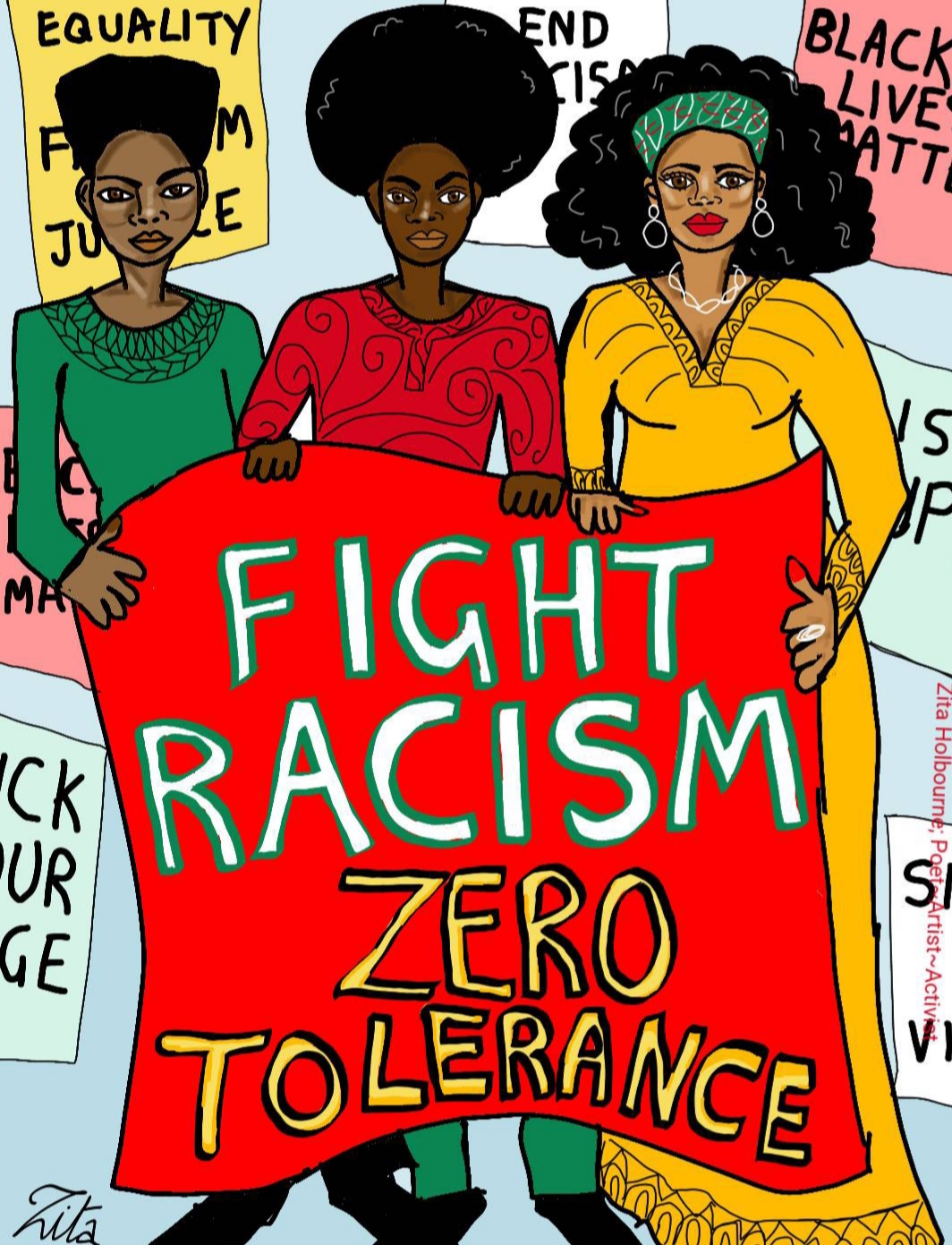
Art by Zita Holbourne, Poet~Artist~Activist
Read original here
Letter in the Independent newspaper here
From the Centre for Migration Advice and Research on behalf of the assigned signatories
c/o McKenzie Beute and Pope
The Woodlawns Centre 16 Leigham Court Road Streatham London SW16 2PJ
jacqueline@mckenziebeuteandpope.com
Dr Tony Sewell
Commission on Race and Ethnic Disparities
10 Victoria Street
London
SW1A 0NN 9 April 2021
Dear Dr Tony Sewell,
Re: The 31 March 2021 Report of the Commission on Race and Ethnic Disparities
We have read the report by the Commission on Race and Ethnic Disparities, published on 31
March 2021, for which you wrote the foreword as chair of the Commission. We are made up
of, and represent, the victims of the Windrush scandal, as the lead organisations, lawyers,
campaigners, researchers and others supporting those affected by the scandal in a myriad of
ways. We are concerned to find that your report appears to have ignored the Windrush
scandal, exposed in late 2017/early 2018 as one of the most significant instances of group
discrimination of our time. The systematic discrimination of the Black community known as
the Windrush generation demonstrates not only how the acts of institutions and the state
negatively affects the lives of Black people in the UK, but how this has gone onto impact
upon future generations.
The injustices meted out to the Windrush generation are therefore well-known. Why then is
the only reference to the scandal in your report a suggestion that those affected feel let
down? Let down? This is not how we would describe it. Lives have been destroyed. For
example, several claimants to the Windrush compensation scheme, whose stories were
published in the press forcing the government to apologise and take action, died due to
health complications caused in part by the stress of their situation, long before they ever
received any compensation.
In your introduction, you refer to your team having spoken to communities as part of your
engagement. Why then did you not speak to those of us who are directly affected by the
Windrush scandal or who are part of over thirty organisations working to support the
thousands of people directly affected?
There does not appear to be much support for your report and generally we agree with the
criticisms levelled against it. We are at a loss to understand how you arrived at the
conclusions you did with the vast amount of independent data available to you. Intrigue on
your method of scholarship aside, we are stunned and heartbroken at your attempt to defile
the memory of those who were subjected to the brutality of the transatlantic slave trade
and the systematic oppressions that followed it, by recasting their experience, and your
1.
ignorance of the impact on subsequent generations. There is no experience of that Maafa1
other than an honest admission of how people were dehumanised and subjugated purely
because of their race.
From the report, we were looking for an appraisal of how the racism that dehumanised
during the slave trade, continues to blight the lives of its descendants, and what you
planned to do to tackle the intergenerational consequences. Instead, your report is a
dreadful attempt to rewrite history and denigrate it to a footnote. You are effectively
denying the true experiences and existences of Black people, so that the annals of history
will once again favour the oppressors.
You say in your report that historic experiences haunt the present and that there is a
reluctance to acknowledge that the UK has become open and fairer. Are you not aware that
despite the aggravating features of the hostile environment, the current injustices are
historic in nature? The origins of these more contemporary injustices are steeped in historic
legislation fuelled by people like Enoch Powell, Oswald Mosely and Margaret Thatcher, the
latter of whom referred to this country as becoming swamped by migrants. Do you think
that these injustices are imagined? Do you think the lived experience of the victims of these
injustices should be ignored?
Some of us and people we know have been denied lifesaving medical treatment, lost jobs
and houses, have been detained, removed and deported from the UK. People we know
have died and large numbers are affected by ongoing trauma – an intergenerational trauma.
Have you noticed that the victims of the Windrush scandal are mostly people of African and
Caribbean descent?
You find that an unexplained approach to closing disparity gaps is the extent to which
individuals and their communities ought to help themselves through their own agency,
rather than waiting for “invisible external forces” to assemble to do the job. Are you saying
then that those affected by the Windrush scandal brought the problems upon themselves?
Do you think that there is something that could have been done to have stopped the state
from destroying landing cards and records of those who arrived from Commonwealth
countries in the Caribbean? Or from demanding that people pay thousands of pounds that
they did not have to obtain a status that they already held?
Do you know how hard this community has worked to support itself? Though you allude to
knowledge of the role of supplementary schools as a positive force, you appear to have
failed to understand that the need to establish these schools was because of structural,
systemic and institutional racism in the mainstream education sector.
You ascribe a new era to the presence of the Windrush generation in the UK. The historical
one has gone apparently, and you define an era of rebellion which you say has also passed.
According to you, we are now in an era of participation. We are having to second guess
what you might mean by this, but in terms of the Windrush scandal, the one initiative set up
by the Home Office which was meant to involve the meaningful participation of those
affected – a stakeholder group - was dismantled by the Secretary of State just last month,
1Maafa is a term derived from Kiswahili meaning ‘a great disaster or tragedy’ or ‘terrible occurrence’. It is
used to describe the Transatlantic slave trade and its lingering effects.
2
�on the basis that a new Cross-Government Working Group chosen by her would assume the
role.
You say further that you want the children of the Windrush generation to discover their
British heritage. What do you mean precisely? That they are ill informed about their
history? Why do you think that might be? Which child in the UK, of any background, knows
less about the true and complex British history and heritage than any other? Have you read
Wendy William’s Windrush Lessons Learned Review? As you do not appear to have referred
to it in your report. She found that the history of the Windrush generation was
institutionally forgotten and specifically recommended that:
“6 a) The Home Office should devise, implement and review a comprehensive learning and
development programme which makes sure all its existing and new staff learn about the
history of the UK and its relationship with the rest of the world, including Britain’s colonial
history, the history of inward and outward migration and the history of black Britons. This
programme should be developed in partnership with academic experts in historical
migration and should include the findings of this review, and its ethnographic research, to
understand the impact of the department’s decisions.”
The mistreatment of the Windrush generation started on 22 June 1948, when HMT
Windrush anchored off Tilbury Docks, and several MPs at the time sought to turn away free
women and men who had been invited to the UK, sending them to work on a peanut
plantation in Africa instead. Though people thereafter could stay in the UK to work
predominantly in the public sector, they were also subject to everyday racism and
discrimination. Can you not see that their experiences and subsequently those of their
descendants, have been plagued with inequalities and subsequent disparities of
achievement? Despite all the hard work of the Windrush generation to better themselves,
their families and support British society, the evidence shows that the systemic inequality
that plagued the first generation and their descendants continue to suffer worsening
outcomes in almost every area of life including education, health, mental wellbeing,
housing, business ownership, employment and criminal justice.
And how dare you start pitting different nationalities of Black people against another
without doing the necessary work to understand how different histories – histories of
enslavement, for example, and complex migration patterns across different eras – have
impacted on outcomes? Had you spoken to us, or to any academics working in these fields,
we might have been able to tell you this.
You find that Britain is no longer a country with a system rigged against ethnic minorities.
Several reports before yours have concluded that it is. How did you arrive at such a vastly
different conclusion? What do you think accounts for the conclusions you have reached,
when the same data has elsewhere produced vastly different outcomes? What of the
findings of universities, the civil service, the NHS and the FTSE 100 corporations which
confound yours?
We do not think that the UK is a beacon for any other country. It is steeped in a systemic
and structural racism that extends far beyond the Windrush generation. As direct and
indirect victims of the Windrush scandal and supporters of their cause, we stand in solidarity
with those seeking asylum; those whose families are being torn apart by draconian polices
3
�and extortionate fees; those women and men who are held in immigration detention
centres deemed unfit for human inhabitation; those who have made the UK their home and
face deportation to countries they do not know; those foreign students falsely accused and
disbelieved, like many of our number; and the holiday makers from many non-visa
Caribbean countries who end up in immigration detention centres because an immigration
officer has decided that their reasons for visiting the UK are not legitimate, to name just a
few. We are astonished that your report is silent on these matters, which form part of the
complex combination of factors that affect how and which communities advance in society.
Who is it that creates the policies, rules and legislation that disproportionately impacts upon
Black people? Who created a right-to-rent scheme, which was found to influence landlords
on whether they choose to rent to people of different backgrounds? Who came up with a
system that required employers, schools, nurseries and doctors to start checking
immigration statuses, and which caused so many to wrongly lose their jobs, livelihoods and
in some cases their will to live?
You state that those from the Black Caribbean ethnic group, which includes the first
generation of Windrush victims, makes up one of the longer-standing migrant groups in the
UK. You then conclude that minorities who have long been established in the country, in a
context of persistent racial and socio-economic disadvantage, may be the least likely to be
optimistic about the potential for social mobility and education to transform their lives.
Again, not only do you ignore your own evidence, especially in relation to the historical and
current role of supplementary schools as one example, but you ignorantly neglect to
consider the aspirations of that first generation. That generation hoped that their children
would have opportunities that they did not, only to discover that the system sent their
children to approved schools, or told their children that they could not aspire to certain
exams, universities or career choices. This broke their hearts.
We were also puzzled by this statement:
“The Commission further recognises the wisdom and lived experience of the Windrush
generation that has seen the changing shape of race relations in the UK, from which
the young can learn. This knowledge needs to be framed into a message that speaks
more about responsibilities, conflict resolution, and the building of bridges.”
Do you think that members of the Windrush generation have burnt bridges, inspired conflict
and/or are being irresponsible?
Though Wendy Williams did not make a definitive finding of institutional racism in the Home
Office, following her review into the Windrush scandal, she did express serious concern that
the department’s failings demonstrated an institutional ignorance and thoughtlessness
towards race and history, which were consistent with some elements of the definition of
institutional racism.
If you have some of the elements of racism, there is racism. If it comes from an institution,
it is institutional. If there is evidence that a racial group is disproportionately disadvantaged
in and by bodies such as courts and tribunals, schools and universities, hospitals and the
police and in private and social organisations across sectors, then that racism might well be
structural.
4
�We ask that you listen to the many experts in race, culture and society who have spoken out
this past week and for many years on these issues. We have listened to them too. You
should look particularly closely at the work of Tendayi Achiume, the UN Special Rapporteur
on contemporary forms of racism, racial discrimination, xenophobia and related intolerance,
who found in June 2019 that the UK Government’s policies exacerbate discrimination, stoke
xenophobic sentiment and further entrench racial inequality. She cited persistent racial
disparities in, among others, education, employment, housing, health, surveillance,
interactions with police, prosecutions, and incarceration. She found:
“Notwithstanding the existence of a legal framework devoted to combating racial
discrimination, the harsh reality is that race, ethnicity, religion, gender, disability status
and related categories all continue to determine the life chances and well-being of people
in Britain in ways that are unacceptable and, in many cases, unlawful;” and
"Undoubtedly, the UK’s attempts to collect disaggregated data, review discriminatory
outcomes, and draft action plans are vital to the realization of the human right to racial
equality. "However, the Government must not confuse data collection and piecemeal
reviews for the action it obliged to take under international human rights law. The
Government has a duty to undertake comprehensive reviews and implement without
delay concrete steps targeted to ending racial discrimination and ensuring racial equality."
We believe that you must now revisit your work and examine the data more closely, seek
evidence from a wider variety of sources, consult experts in a credible way and start to draw
conclusions based on the facts. If you cannot do that, then you should stand down from a
commission that is meant to be investigating race and disparity to understand the current
issues and how government and society can work together to address them. We look
forward to hearing from you and in the interim, we would be grateful if you could use your
position to ensure that the 30 recommendations of Wendy Williams are implemented in a
timely manner because the issues raised by the Windrush scandal, are ongoing.
Yours sincerely,
[See overleaf for signatories]
CC:
The Rt Hon Boris Johnson MP Prime Minister
The Rt Hon Priti Patel MP Secretary of State for the Home Department
5
�The people signing this letter all have a connection with Windrush injustice. Some are direct
victims and some are from organisations working with those directly affected. We have split
the list into organisational representatives and individuals signing in their own right.
Organisations:
Jacqueline McKenzie: McKenzie Beute and Pope & Centre for Migration Advice and
Research’s Windrush Justice Project
Michele Beute: McKenzie Beute and Pope
Anthony Hillary: McKenzie Beute and Pope
Jerome Bond: McKenzie Beute and Pope
Arthur Torrington CBE: Windrush Foundation
Professor Gus John: Communities Empowerment Network.
Windrush Lives: advocacy and support group for Windrush victims
Windrush Compensation Project: University of Leicester
Dawn Hill: Windrush National Organisation and Black Cultural Archives
Cllr Sonia Winifred: Cabinet Member Equalities and Culture London Borough of Lambeth
Councillor Patsy Cummings: Race Equality Champion London Borough of Croydon
Councillor Carole Williams: Cabinet member for employment and skills and HR London
Borough of Hackney
Councillor Callton Young OBE, Chair of Croydon African Caribbean Family Organisation, and
Cabinet Member and Windrush Champion London Borough of Croydon
Dr Suzella Palmer: Applied Social Studies University of Bedfordshire
Judge D Peter Herbert O.B.E: Chair BAME Lawyers for Justice & retired Chair of the Society
of Black Lawyers)
Lee Jasper: Vice Chair BAME Lawyers for Justice
Miranda Grell: BAME Lawyers for Justice
Zita Holbourne: National Chair and Founder of BARAC UK and BAME Lawyers for Justice
Donna Guthrie: BARAC UK and BAME Lawyers for Justice
Bishop Dr Desmond Jaddoo: Chair Windrush National Organisation and Windrush
Birmingham
Reverend Clive Foster: Vice Chair Windrush National Organisation and Windrush
Nottingham
Councillor Jacqueline Burnett: Windrush National Organisation and Windrush Luton
Anthony Brown: Windrush National Organisation and WD Legal Manchester
Claude Hendrickson: Windrush National Organisation and Race Card Leeds Project
Glenda Caesar: Windrush National Organisation and Windrush Lives
Jean Prescod: Windrush National Organisation and Septimus Severus Coventry
Glenda Andrew: Windrush National Organisation and Preston Windrush Generation
Descendants
Charlie Williams Windrush National Organisation and Windrush Birmingham
Neil Mukherjee: Windrush National Organisation and Windrush Legacy Oxon
Sibon Phiri: United Legal Access
Melanie Clarke: United Legal Access
Samantha Young: Windrush Legal Angels
Tarjee Clarke: Windrush Legal Angels
Dr Gifty Edila: Windrush Justice Clinic
Anna Steiner: University of Westminster and Windrush Justice Clinic
6
�Sally Causer: Southwark Law Centre and Windrush Justice Clinic
Holly Stow: Windrush Justice Clinic
Bella Sankey: Detention Action
Dianne Greyson: Equilibrium Mediation Consulting and Ethnicity Pay Gap Campaign
Carol Cooper: Global Talent Compass
Luke Daniels: Caribbean Labour Solidarity
Kingsley Abrams: Momentum Black Caucus (MBC)
Yvette Williams: Justice 4 Grenfell
Clive Phillip: Mangrove Community Association
Ngoma Silver: Leopold School (Harlesden) Renaming Group
Bob Foster: Windrush Nurses and Beyond Foundation
Nana Asante: IPAD Coalition UK
Nana Haja Salifu: European Network of People of African Descent
Olalekan Odedeyi: Save the Woman
Naglaa Sadik Mustafa: Abdul Mageed Educational Trust
Mojisola Sorunke: The African Sang
Ishmahil Blagrove JR: Rice and Peas
Joan Hall: Just Education Matters
Shaun Pascal: Black Wall Street Media
Esther Armah: The Armah Institute of Emotional Justice
Glen Watson: RMTs Black Solidarity Committee
Individuals:
Anna Rothery: Lord Mayor of Liverpool
Lord Simon Woolley
Professor Sir Geoff Palmer OBE CD
Professor Leslie Thomas QC: Barrister
Martin Forde QC: Barrister
Marcia Willis Stewart QC (hon): Solicitor
Professor Sara Chandler QC (hon)
Leroy Logan MBE
Dr Shola Mos-Shogbamimu
Dr Sandra Richards
Charles Crichlow: former president of the National Black Police Association
Lewitt Nurse: Barrister
Grace Brown: Barrister
David Neita: Barrister
Akima Paul Lambert: Solicitor Advocate
Evelyn Ofori-Koree: Solicitor Advocate
Frances Swaine: Solicitor
Pamela Robotham: Solicitor
Catherine Evans: Solicitor
Sally Gill: Solicitor
Paul McFarlane: Solicitor
Donna Samuels: Solicitor
Pamela Dosu: Solicitor
Darlene Waithe: Solicitor
Tinu Adeshile: Solicitor
7
�Sharon Thomas: Solicitor
Ama Ocansey: Solicitor
Joy Van-Cooten: Solicitor
Geraldine Cumberbatch: Solicitor
Sally- Ann Meade: Solicitor
Alex Pascall OBE
Patrick Vernon OBE
Rev Fujo Malaika
Alexandra Ankrah
Yvonne Witter
Natasha Dyer-Williams
Dennot Nyack
David Weaver
Kadi Wilson
Tonika Stephenson
Kimberly McIntosh
Sentina Bristol
Gertrude Ngozi Chinegwundoh
Roy Lee
Adebowale Adelodun
Lebert McLeod
Teresa W. Joseph-Loewenthal
Lorna Downer
Sara Louise-Burke
Bobby Holder
Louis Smart
Vonfil Johnson
Joycelyn John
Ros Griffiths
Barbara Lindsay
Elizabeth Madden
Annemarie Madden
Luigi Madden
Andrew Madden
Shaa Madden
Sherry Ann Desmangles
Danny Hippolyte
Dexter Hippolyte
Christopher Oliver
Veronique Belinga
Vernon Vanriel
Louis Smart
Yvonne Mark
Annie Campbell Viswanathan
Sulekha Hassan
Sophia Mangera
Margaret Greer
8
�Alexandra Braithwaite
Angie Le Mar
Chardine Taylor-Stone
Marlene Clarke
9